Looking Back at the Timeline Before Entering Phase 2
In 2024, the RWA market proved that financial institutions could accept tokenization. BlackRock launched BUIDL and people bought it. Franklin Templeton launched BENJI and people bought it. The market grew 85% in a single year.
But what happened in 2025 and continues until now is different. Institutions are no longer just investing in tokenized assets. They are using them further, such as using them as collateral for trading on decentralized exchanges or connecting them with DeFi, as seen in the case of BlackRock BUIDL being placed on Uniswap.
This was the first time we saw a regulated project appear on a decentralized exchange.
That is the dividing line between Phase 1 and Phase 2.
Market Direction from Phase 1 to Phase 2
In Phase 1, the TVL numbers of the RWA market clearly showed that the market was still at the beginning of full expansion. Treasury and private credit accounted for 70-73% of total market value. Both are assets that institutions are already familiar with in terms of lower risk and verifiable yield. The highlight of Phase 1 was BlackRock’s BUIDL, which became the world’s largest tokenized fund within just a few months after launch and proved that institutional-grade asset tokenization could actually work.
Entering Phase 2, the overall picture began to change as tokenized commodities grew by 289%, from $1.43 billion to $5.55 billion. Tokenized stocks, which only began in mid-2025, rose to $487 million. The market share of Treasury declined from 73.7% to 67.2%, not because Treasury shrank, but because other asset classes grew faster. All of this happened within Q1 2026.
What shows that Phase 2 has truly arrived is not only the larger numbers, but the change in behavior. Beyond bringing assets into tokenization for investment, tokenization is becoming digital financial infrastructure that can already be used as collateral for transactions on blockchain. Today, tokenization is infrastructure that the global financial system is building together.
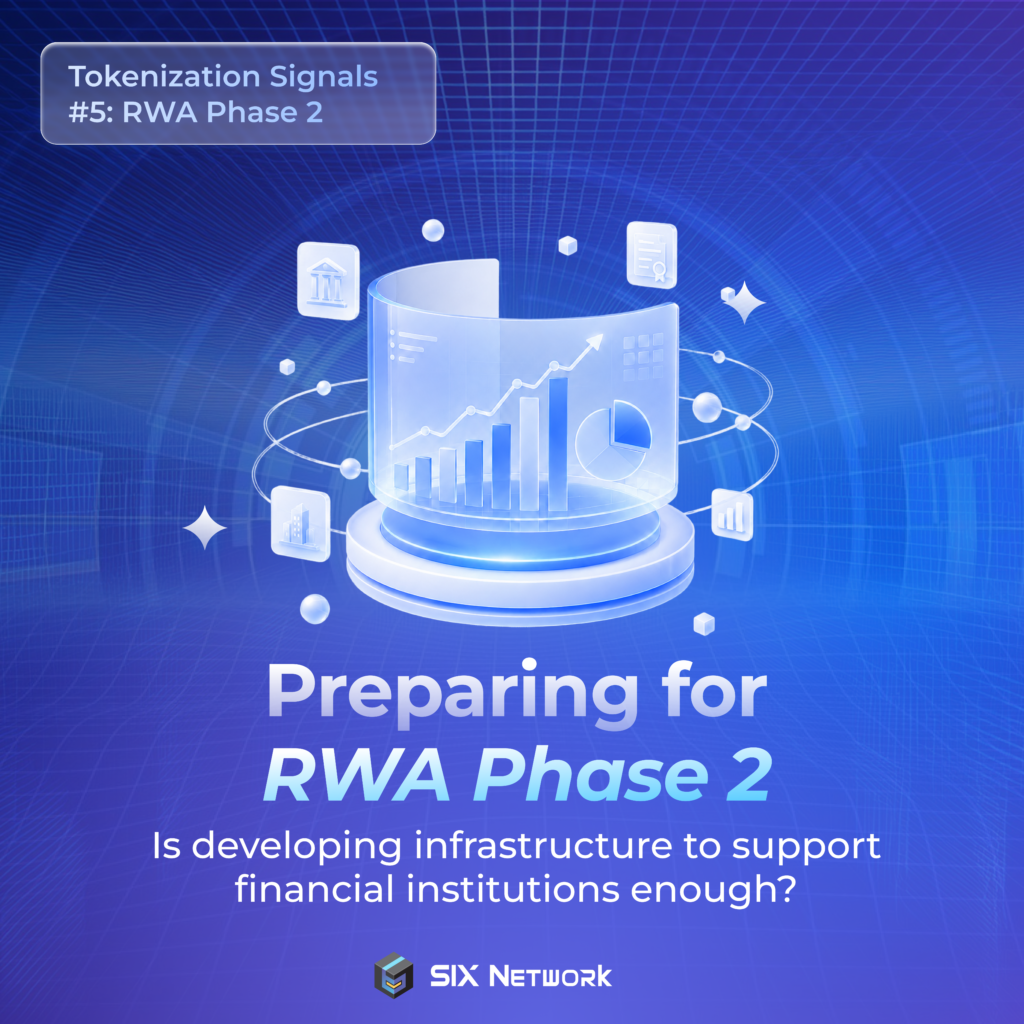
At a time this intense, is simply developing RWA infrastructure enough?
SIX Network’s Preparation
SIX Network has seen the growth of the market and the entry of institutional players ahead of time. This aligns with our 2026 roadmap theme, “Institutional Assets and Financial Infrastructure,” which matches the direction the market is currently moving toward.
Although Thailand may still face some challenges around regulatory frameworks and still needs clearer legal direction, the signals this year are becoming more positive. There is growing interest from the business sector, along with continued movement toward building a digital asset framework. The Thai market has significant interest in RWA Tokenization, but it is still waiting to see which use cases will emerge in a clear and concrete form first.
For SIX Network, we already have real use cases through Pas.ss, an on-chain privilege management platform that serves as a bridge for delivering benefits to token holders of different projects. One recent example is Pas.ss connecting special privileges with AQUAROUS Token holders, one of AssetWise’s projects. This is a clear example showing that tokenized assets do not stop at investment, but can expand into real experiences for token holders.
On the asset side, SiriHub2, a real estate project worth 2.49 billion baht, is tokenized on SIX Protocol. Together with other assets, this has brought the total on-chain asset value on SIX Protocol to more than $90 million. All of these are real assets from real businesses in this region.
So, is infrastructure development enough?
The structure is already ready for use. What comes next is expanding use cases and supporting new players that are entering alongside the growth of Phase 2.