fbpx

Series Blog 4: Operationalizing Regulatory Architecture

Series Blog 4: Operationalizing Regulatory Architecture

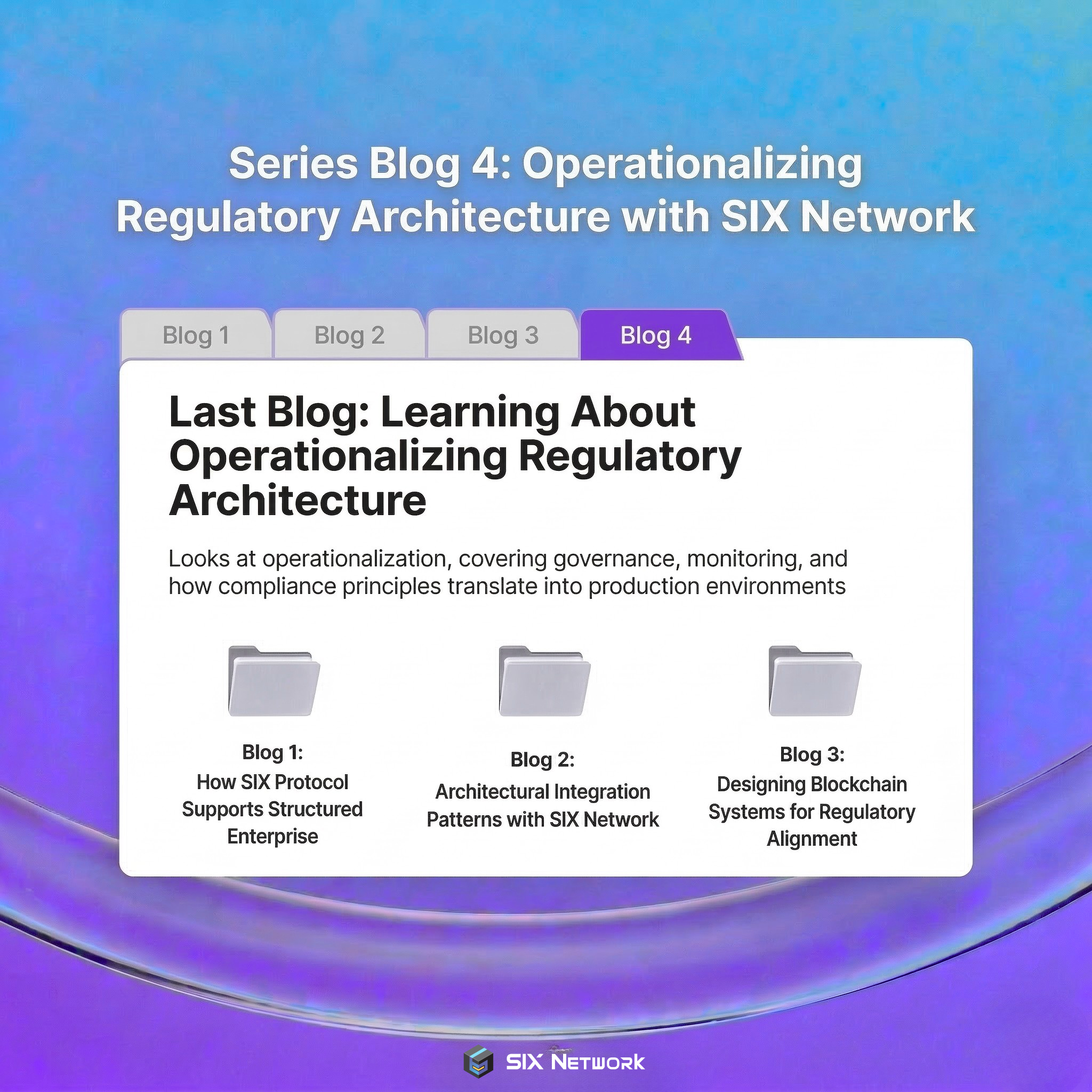
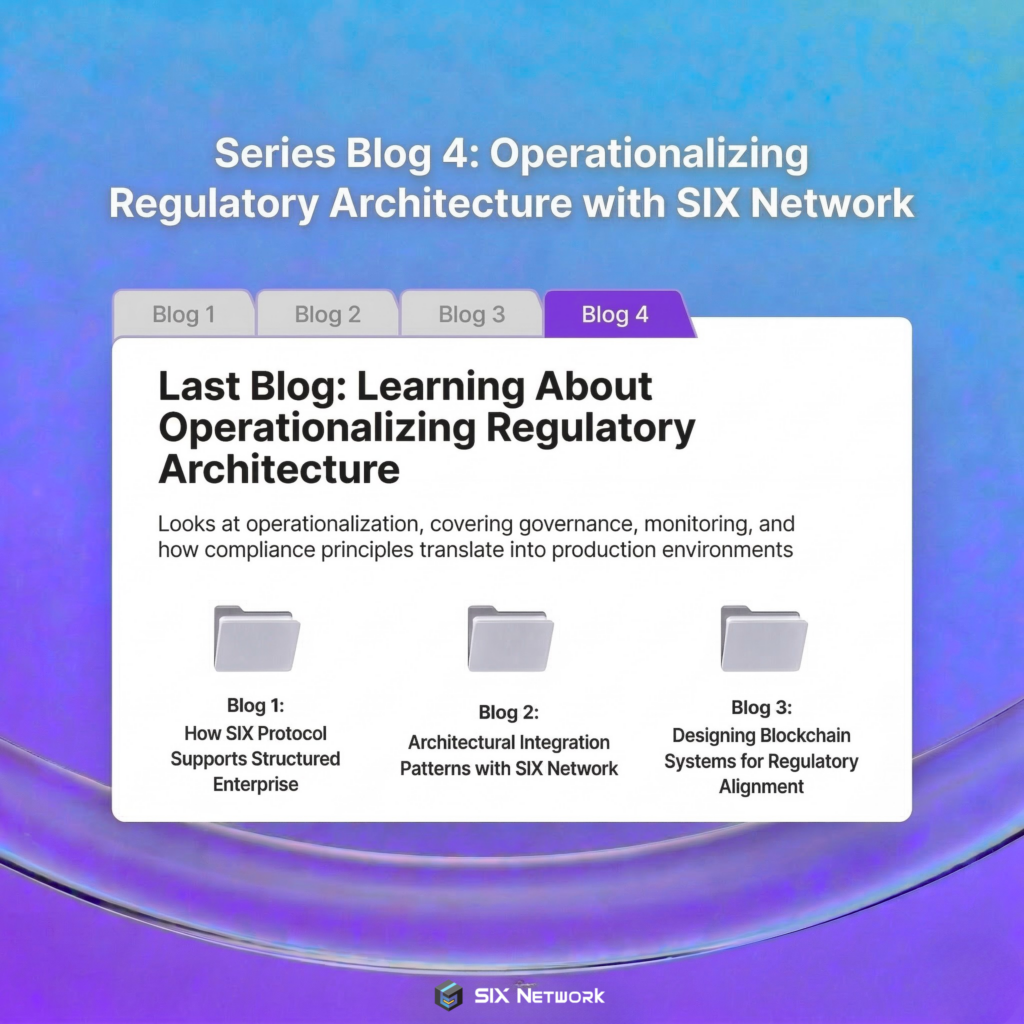
Series Blog 4 Operationalizing Regulatory Architecture with SIX Network

Understanding regulatory principles is only the first step. The more difficult challenge lies in operationalizing those principles within live systems.


Moving from compliance design to production deployment requires coordination between architecture, legal, operations, and security teams.


Embedding Compliance into Operational Workflows


Rather than treating compliance as a reporting function, mature architectures embed regulatory controls into transaction workflows.


Examples include:

• Multi-level approval processes before transaction finalization

• Automated logging of authorization events

• Clearly defined retention and archival policies

• Defined escalation paths for exceptional cases


These controls are implemented primarily in enterprise application logic and governance frameworks. Blockchain serves as a verifiable execution and recording layer.


SIX Garage and related tooling can assist in structuring asset management and permission workflows, but they operate within broader governance systems defined by the organization.


Monitoring and Continuous Oversight


Production systems require observability. Compliance does not end at deployment; it requires continuous oversight.


Architectural monitoring typically covers:

• Transaction latency and failure rates

• Role misuse or unauthorized access attempts

• Data consistency across on-chain and off-chain components

• Audit trail completeness


SIX Network infrastructure can be integrated into existing monitoring frameworks, allowing blockchain operations to be managed alongside other enterprise systems.


From Policy to Implementation


Regulatory frameworks such as GDPR, HIPAA, SOX, or AML/KYC define principles. Implementation varies by jurisdiction and organization.


No protocol can automatically guarantee compliance across all contexts. Instead, infrastructure should provide flexibility and traceability that enable organizations to implement their own compliance interpretations.


SIX Network’s approach emphasizes architectural support rather than automated regulatory guarantees.


Conclusion


Enterprise blockchain deployment in regulated environments requires architectural rigor, governance clarity, and operational discipline.


SIX Network’s standards-based protocol and supporting tools are designed to align with these enterprise requirements, not to replace them.


By approaching integration and compliance as architectural challenges rather than marketing features, organizations can move toward sustainable, production-ready blockchain adoption.

⎯⎯⎯⎯⎯⎯⎯⎯⎯⎯⎯⎯⎯⎯⎯⎯⎯⎯⎯⎯⎯⎯⎯⎯⎯⎯⎯⎯⎯⎯⎯⎯

Disclaimer:

1.This article is intended for informational purposes only. Please conduct your own research before making any investment decisions related to cryptocurrencies 2. Cryptocurrency and digital token involve high risk; investors may lose all investment money and should study information carefully and make investments according to their own risk profile.


Don’t miss out follow us at:

Warisara Thepsiri
Warisara Thepsiri

Experience the magic of Blockchain with SIX Network!

Related Posts

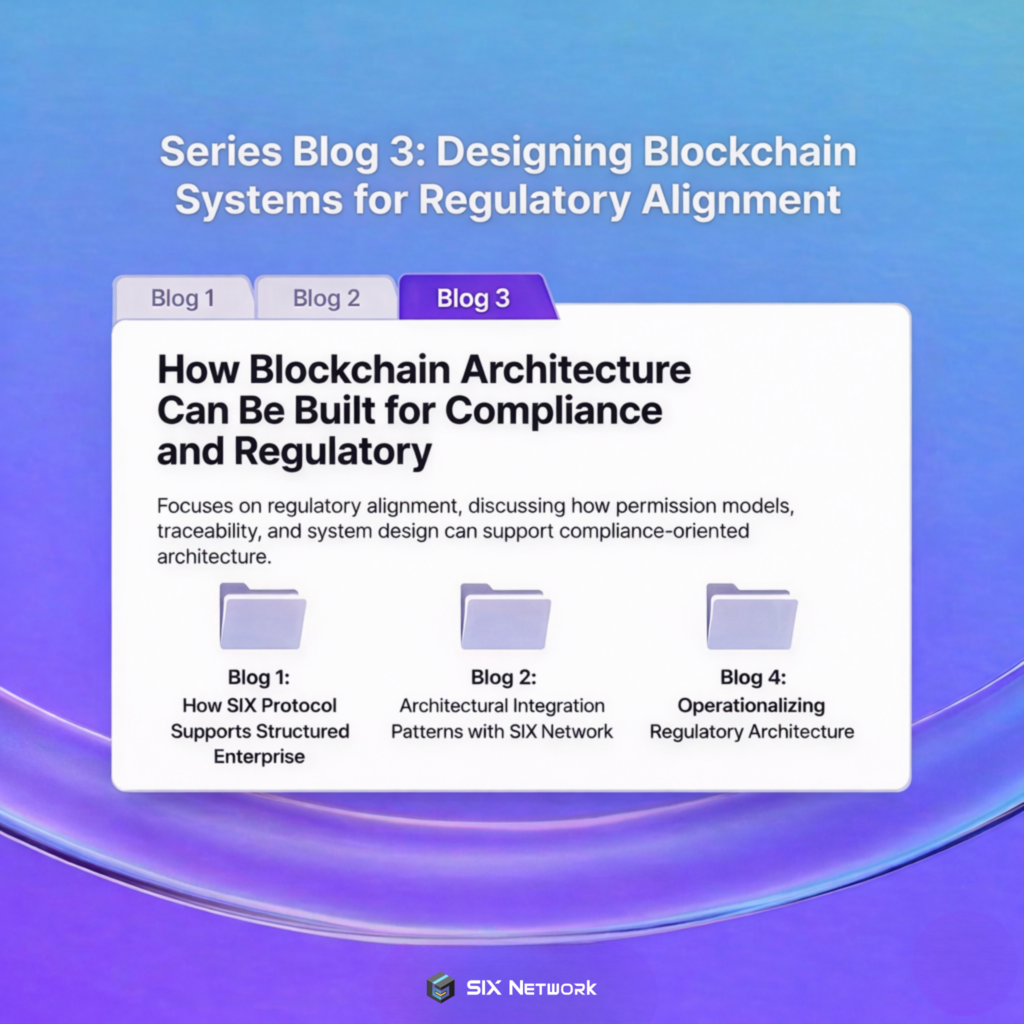
Series Blog 3: Designing Blockchain for Regulatory Alignment

Series Blog 3: Designing Blockchain for Regulatory Alignment

Series Blog 3 Designing Blockchain Systems for Regulatory Alignment

Enter to Blog 3: How Blockchain Architecture Can Be Built for Compliance and Regulatory


Compliance concerns often surface early in blockchain discussions. Questions about immutability, data protection, and auditability frequently delay adoption decisions.


However, many compliance challenges arise not from blockchain itself, but from incomplete architectural design. Regulatory alignment is rarely achieved through features alone. It requires deliberate system partitioning and governance modeling.


This article explores how compliance can be approached as an architectural principle rather than a reactive requirement.


Separation of On-Chain and Off-Chain Data

One of the most common misconceptions is that all operational data must reside on-chain. In regulated environments, this is rarely appropriate.


A structured architecture typically separates:

• Transaction proofs and hashes (on-chain)

• Sensitive or personal data (off-chain, within controlled databases)


Blockchain functions as an integrity and verification layer rather than a primary data repository.


SIX Protocol can support this model because it does not impose a rigid data storage architecture. Organizations retain flexibility in determining what information is recorded on-chain.


Permissioned Control and Identity Mapping


Regulatory frameworks often require clear attribution of actions. This means system architecture must map enterprise identity management systems to blockchain-level roles.


Permissioned models allow organizations to define who can initiate, approve, or view specific transactions. However, identity verification and access governance remain enterprise responsibilities.


SIX Protocol’s permission structures and traceable transaction metadata can support this alignment, but compliance ultimately depends on governance processes and audit design.


Auditability Without Overexposure


Another common concern involves transparency. Public blockchains expose transaction data broadly, which may conflict with confidentiality requirements.


Architectural strategies such as encryption, role-based access control, and metadata minimization allow organizations to maintain auditability without disclosing unnecessary information.


The objective is controlled transparency, providing regulators and auditors with verifiable records while limiting exposure of sensitive business data.


Complete Your Design Blockchain Systems 


Compliance should not be treated as a secondary checklist applied after system deployment. It must inform architectural decisions from the beginning.


SIX Protocol provides technical capabilities, permission models, traceability, and integration flexibility that can support compliance-oriented design. However, regulatory alignment is achieved through thoughtful system architecture and operational governance.


In the final article, we explore practical considerations for moving from compliance design principles to operational deployment.


────────────────────────────────────


Learn more about SIX Network

Website l Telegram l Twitter l Facebook l Discord l Medium

⎯⎯⎯⎯⎯⎯⎯⎯⎯⎯⎯⎯⎯⎯⎯⎯⎯⎯⎯⎯⎯⎯⎯⎯⎯⎯⎯⎯⎯⎯⎯⎯

Disclaimer:

1.This article is intended for informational purposes only. Please conduct your own research before making any investment decisions related to cryptocurrencies 2. Cryptocurrency and digital token involve high risk; investors may lose all investment money and should study information carefully and make investments according to their own risk profile.


Don’t miss out follow us at:

Warisara Thepsiri
Warisara Thepsiri

Experience the magic of Blockchain with SIX Network!

Related Posts

Series Blog 2: Architectural Integration Patterns with SIX Network

Series Blog 2: Architectural Integration Patterns with SIX Network

Series Blog2: Architectural Integration Patterns with SIX Network

Enter to Blog 2: Architectural Integration Patterns with SIX Network


In the previous article, we discussed how standards alignment, particularly EVM compatibility, reduces friction during enterprise blockchain adoption. However, compatibility alone does not solve integration complexity. What determines long-term success is architectural discipline.


Enterprise blockchain integration should not be treated as a feature implementation. It is an architectural extension of the existing system landscape. Without clear boundaries and integration patterns, blockchain components risk becoming tightly coupled to core systems, increasing operational risk and long-term maintenance cost.


This article examines architectural integration approaches that can be applied when working with SIX Protocol.


The Adapter Layer as an Architectural Boundary


One of the most reliable integration strategies in enterprise environments is the introduction of an adapter or middleware layer between core systems and blockchain infrastructure.


Instead of allowing ERP or CRM systems to directly interact with smart contracts, a controlled integration layer handles:

• Data transformation

• Transaction creation

• Signing and authorization

• Error handling and retry logic


This separation ensures that blockchain-specific concerns remain isolated. Core enterprise systems continue operating using their existing data models and workflows.

SIX Protocol’s standards-based execution environment allows this boundary to be implemented without proprietary constraints. Because it follows EVM standards, integration layers can leverage widely available libraries and established development patterns.


The objective is not simplification through abstraction alone, but architectural containment. Blockchain logic becomes a replaceable or evolvable component rather than a deeply embedded dependency.


Event-Driven Recording Without System Disruption


Many enterprise systems already rely on event-driven architectures. In such environments, blockchain should function as a recording or verification layer triggered by specific business events, rather than as the primary transaction processor.


For example, when an order is finalized or a compliance approval is completed, an event can be emitted internally. A blockchain integration service listens to these events and records relevant transaction metadata onchain.


This approach provides traceability without requiring the core business system to be redesigned. It also reduces operational risk, as business continuity does not depend on blockchain availability.


SIX Protocol supports this model because it does not require tightly coupled execution patterns. It can function as an external integrity layer that complements existing workflows.


Designing for Governance and Observability


Enterprise architects must consider governance and monitoring from the beginning. Blockchain components should integrate into existing operational monitoring frameworks rather than exist as isolated infrastructure.


Key architectural considerations typically include:

• How transaction states are monitored

• How failures are surfaced to operations teams

• How audit logs are correlated across systems

• How identity and permission models map between enterprise systems and blockchain roles


SIX Protocol’s permission capabilities and transaction traceability can support governance design, but they do not replace it. Governance remains an architectural responsibility.


Key Takeaway

Successful blockchain integration is less about adding distributed infrastructure and more about disciplined system design. Adapter layers, event-driven recording, and governance mapping are architectural tools, not product features.


SIX Network’s design choices allow these architectural strategies to be applied without introducing proprietary execution models or isolated tooling stacks.


In the next article, we shift focus from integration patterns to regulatory architecture and compliance-oriented design.


────────────────────────────────────

Learn more about SIX Network

Website l Telegram l Twitter l Facebook l Discord l Medium
⎯⎯⎯⎯⎯⎯⎯⎯⎯⎯⎯⎯⎯⎯⎯⎯⎯⎯⎯⎯⎯⎯⎯⎯⎯⎯⎯⎯⎯⎯⎯⎯

Disclaimer:

1.This article is intended for informational purposes only. Please conduct your own research before making any investment decisions related to cryptocurrencies 2. Cryptocurrency and digital token involve high risk; investors may lose all investment money and should study information carefully and make investments according to their own risk profile.


Don’t miss out follow us at:

Warisara Thepsiri
Warisara Thepsiri

Experience the magic of Blockchain with SIX Network!

Related Posts

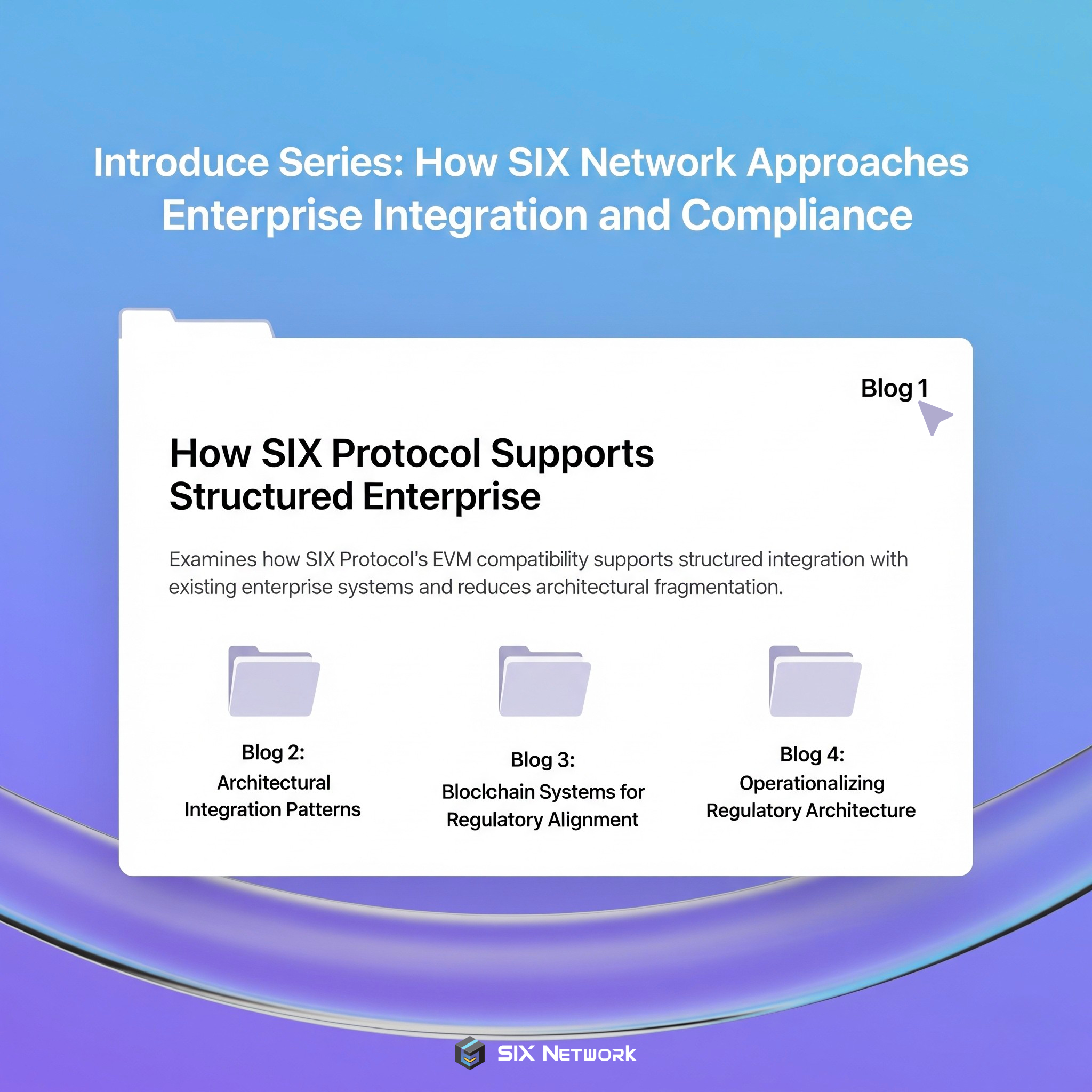
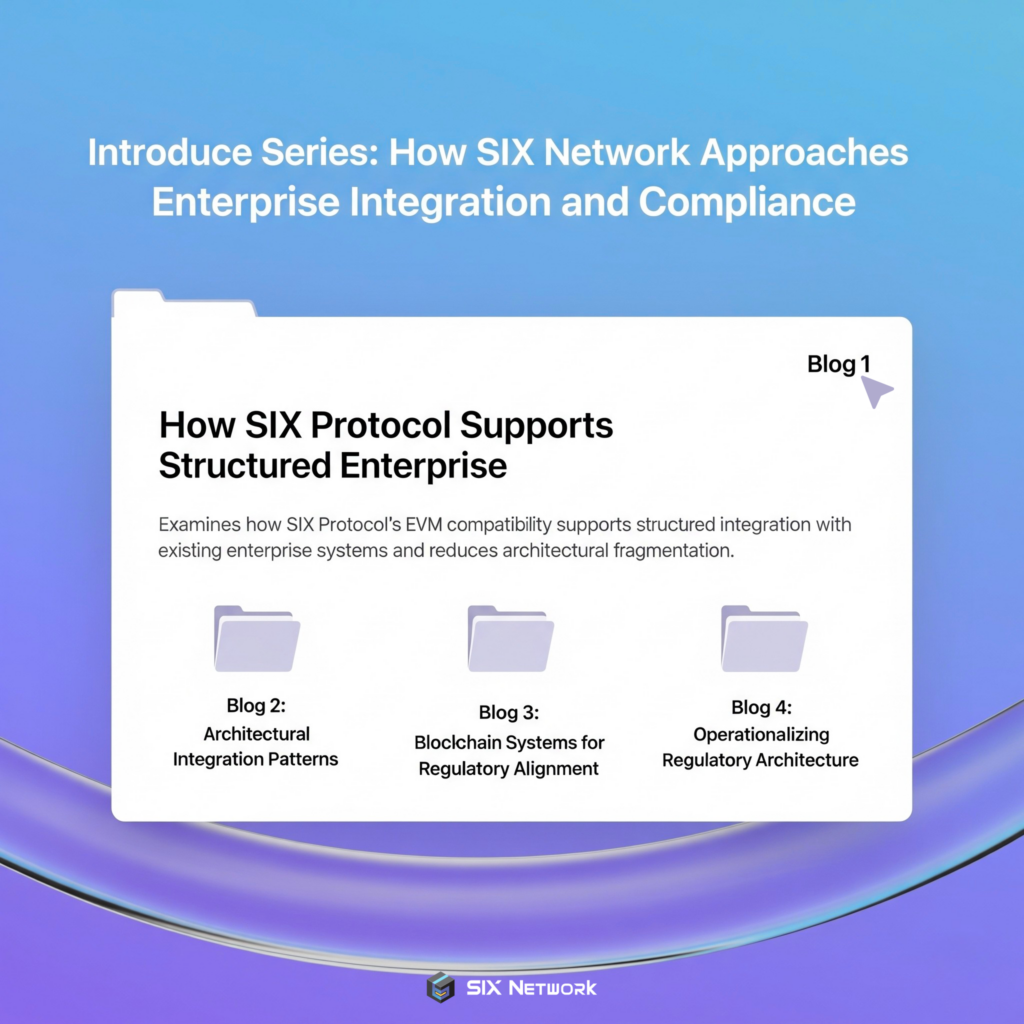
Introduce Series: How SIX Network Approaches Enterprise Integration and Compliance

Introduce Series: How SIX Network Approaches Enterprise Integration and Compliance

Introduce Series: How SIX Network Approaches Enterprise Integration and Compliance Blog 1

Enterprise blockchain adoption often slows down not because of the technology itself, but because of integration complexity and regulatory considerations. This four-part blog series explores how SIX Network approaches these challenges from an architectural perspective.


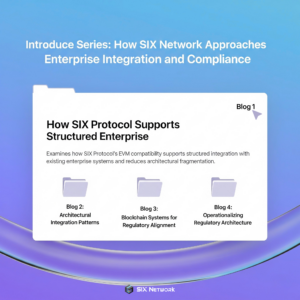
Blog 1 examines how SIX Protocol’s EVM compatibility supports structured integration with existing enterprise systems and reduces architectural fragmentation.

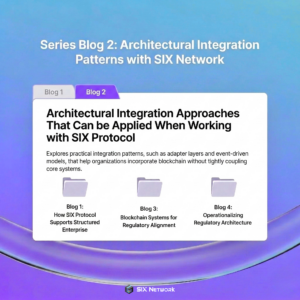
Blog 2 explores practical integration patterns, such as adapter layers and event-driven models, that help organizations incorporate blockchain without tightly coupling core systems.

Blog 3 focuses on regulatory alignment, discussing how permission models, traceability, and system design can support compliance-oriented architecture.

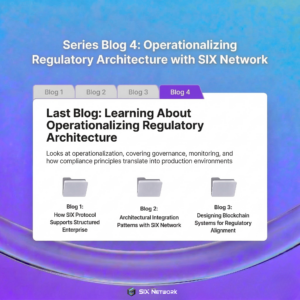
Blog 4 looks at operationalization, covering governance, monitoring, and how compliance principles translate into production environments.


Throughout this series, we focus on architectural alignment, governance clarity, and standards-based design as foundations for sustainable enterprise blockchain adoption.


Blog 1

Overcoming Integration Complexity
Part 1: How SIX Protocol Supports Structured Enterprise Blockchain Integration

Enterprise blockchain integration is often perceived as complex and high-risk. In practice, the challenge rarely lies in blockchain technology alone. Instead, complexity arises from how blockchain systems interact with existing enterprise infrastructure, ERP platforms, CRM systems, identity frameworks, data governance models, and regulatory controls.


Many organizations successfully build proof-of-concept projects, but transitioning from pilot to production introduces architectural, operational, and compliance considerations that require structured planning.


SIX Protocol v4.0 was developed with these realities in mind. Rather than introducing a proprietary execution model, SIX Protocol aligns with established industry standards, particularly EVM compatibility. This architectural decision supports integration planning that is more predictable and aligned with existing development ecosystems.


This article is the first in a four-part series exploring how SIX Network approaches integration complexity and regulatory requirements in enterprise environments.


The Practical Role of EVM Compatibility

A common friction point in enterprise adoption is the introduction of new programming languages, tooling stacks, or execution environments. When platforms require proprietary development models, organizations must retrain teams or recruit new talent.


SIX Protocol supports the Ethereum Virtual Machine (EVM) at the core protocol level. Developers can write smart contracts in Solidity and use established development tools such as Hardhat and Truffle. This does not automatically shorten project timelines, but it reduces uncertainty by leveraging a mature ecosystem.


By aligning with widely adopted standards, organizations can reuse existing internal knowledge and external expertise. The decision to support EVM is therefore less about performance marketing and more about minimizing architectural fragmentation.


Supporting Enterprise Workflows Through the SIX Ecosystem

Beyond the protocol layer, SIX Network provides tools that support digital asset implementation.


SIX Garage offers capabilities for issuing and managing digital assets, including token configuration, permission management, and administrative oversight. These functions are designed to assist organizations that require structured governance over digital asset lifecycles.


Pas.ss provides a framework for managing digital privileges and engagement use cases. It integrates with non-custodial wallet models, allowing organizations to implement user-facing digital programs without requiring centralized custody structures.


These tools are not substitutes for enterprise system design. Rather, they serve as building blocks that organizations can integrate into broader digital strategies.


Integration as an Architectural Exercise

Effective enterprise blockchain integration requires separation of concerns. Business logic should remain independent from blockchain execution logic wherever possible. Middleware layers or API gateways can mediate communication between core enterprise systems and blockchain components.


SIX Protocol’s standards-based architecture allows such layering without requiring proprietary infrastructure dependencies. This enables organizations to define clear boundaries between existing systems and blockchain components.


Integration planning should typically include:

• Data flow analysis

• Identity and access control mapping

• Transaction approval workflows

• Monitoring and operational oversight

• Pre-production validation


SIX Network’s design approach supports these structured planning processes rather than replacing them.


Summary

Enterprise blockchain adoption becomes manageable when architectural alignment, governance considerations, and ecosystem compatibility are addressed early.


SIX Protocol’s EVM compatibility and the broader SIX ecosystem are designed to support structured integration planning rather than shortcut it. By relying on established standards and modular tooling, organizations can reduce integration uncertainty and build toward sustainable deployment models.


In the next article, we will examine practical integration patterns that can be applied within enterprise environments using SIX Network infrastructure.

────────────────────────────────────

Learn more about SIX Network

Website l Telegram l Twitter l Facebook l Discord l Medium
⎯⎯⎯⎯⎯⎯⎯⎯⎯⎯⎯⎯⎯⎯⎯⎯⎯⎯⎯⎯⎯⎯⎯⎯⎯⎯⎯⎯⎯⎯⎯⎯

Disclaimer:

1.This article is intended for informational purposes only. Please conduct your own research before making any investment decisions related to cryptocurrencies 2. Cryptocurrency and digital token involve high risk; investors may lose all investment money and should study information carefully and make investments according to their own risk profile.


Don’t miss out follow us at:

Warisara Thepsiri
Warisara Thepsiri

Experience the magic of Blockchain with SIX Network!

Related Posts