fbpx

Series Blog 4: Operationalizing Regulatory Architecture

Series Blog 4: Operationalizing Regulatory Architecture

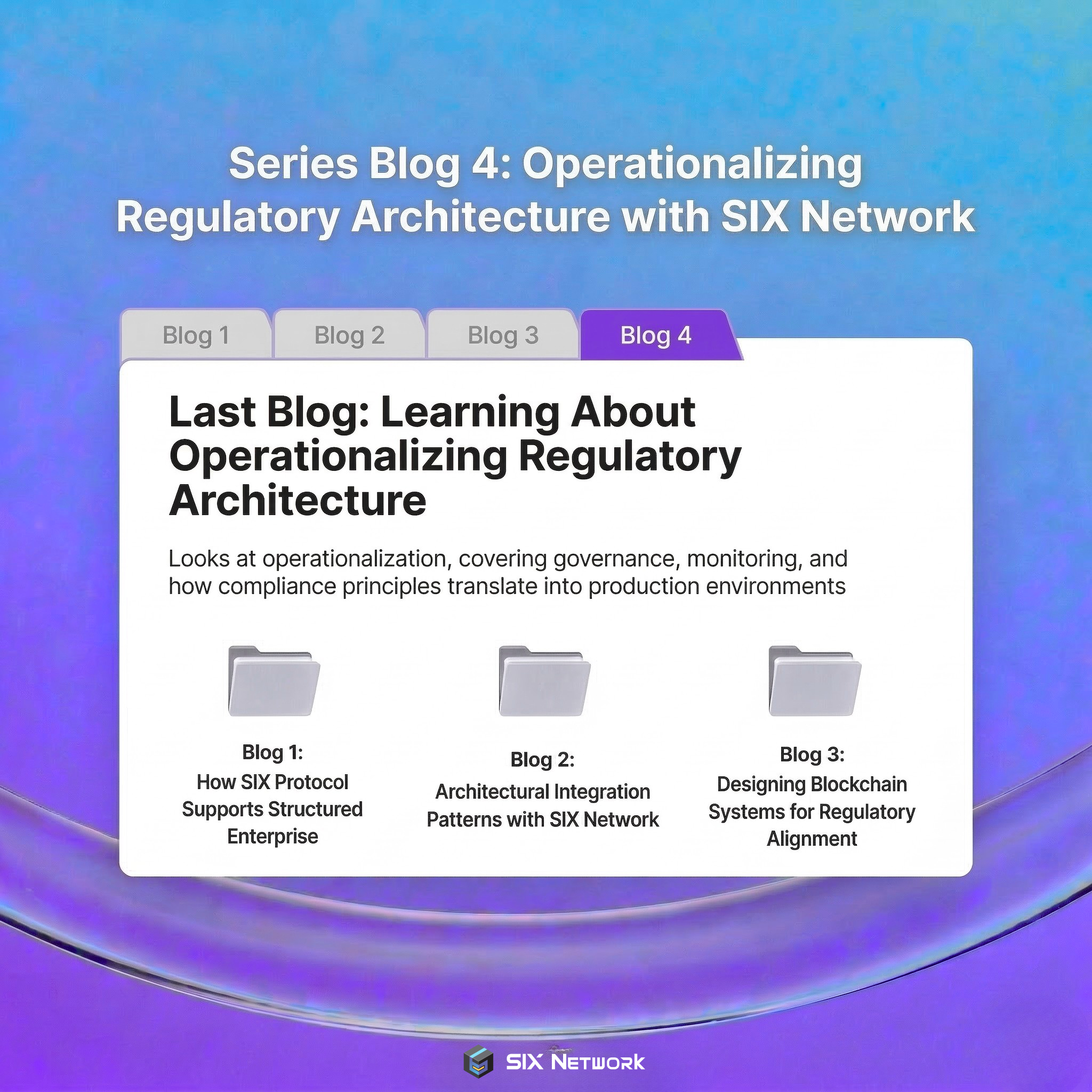
Series Blog 4 Operationalizing Regulatory Architecture with SIX Network

Understanding regulatory principles is only the first step. The more difficult challenge lies in operationalizing those principles within live systems.


Moving from compliance design to production deployment requires coordination between architecture, legal, operations, and security teams.


Embedding Compliance into Operational Workflows


Rather than treating compliance as a reporting function, mature architectures embed regulatory controls into transaction workflows.


Examples include:

• Multi-level approval processes before transaction finalization

• Automated logging of authorization events

• Clearly defined retention and archival policies

• Defined escalation paths for exceptional cases


These controls are implemented primarily in enterprise application logic and governance frameworks. Blockchain serves as a verifiable execution and recording layer.


SIX Garage and related tooling can assist in structuring asset management and permission workflows, but they operate within broader governance systems defined by the organization.


Monitoring and Continuous Oversight


Production systems require observability. Compliance does not end at deployment; it requires continuous oversight.


Architectural monitoring typically covers:

• Transaction latency and failure rates

• Role misuse or unauthorized access attempts

• Data consistency across on-chain and off-chain components

• Audit trail completeness


SIX Network infrastructure can be integrated into existing monitoring frameworks, allowing blockchain operations to be managed alongside other enterprise systems.


From Policy to Implementation


Regulatory frameworks such as GDPR, HIPAA, SOX, or AML/KYC define principles. Implementation varies by jurisdiction and organization.


No protocol can automatically guarantee compliance across all contexts. Instead, infrastructure should provide flexibility and traceability that enable organizations to implement their own compliance interpretations.


SIX Network’s approach emphasizes architectural support rather than automated regulatory guarantees.


Conclusion


Enterprise blockchain deployment in regulated environments requires architectural rigor, governance clarity, and operational discipline.


SIX Network’s standards-based protocol and supporting tools are designed to align with these enterprise requirements, not to replace them.


By approaching integration and compliance as architectural challenges rather than marketing features, organizations can move toward sustainable, production-ready blockchain adoption.

⎯⎯⎯⎯⎯⎯⎯⎯⎯⎯⎯⎯⎯⎯⎯⎯⎯⎯⎯⎯⎯⎯⎯⎯⎯⎯⎯⎯⎯⎯⎯⎯

Disclaimer:

1.This article is intended for informational purposes only. Please conduct your own research before making any investment decisions related to cryptocurrencies 2. Cryptocurrency and digital token involve high risk; investors may lose all investment money and should study information carefully and make investments according to their own risk profile.


Don’t miss out follow us at:

Warisara Thepsiri
Warisara Thepsiri

Experience the magic of Blockchain with SIX Network!

Related Posts

​​SIX Network Announces Partnership with Selanet, AI Agent Infrastructure Developer, to Drive Web3 Ecosystem Growth

SIX Network ประกาศความร่วมมือกับ Selanet ผู้โครงสร้างพื้นฐานสำหรับ AI Agents

SIX Network ประกาศความร่วมมือกับ Selanet ผู้พัฒนา Infrastructure สำหรับ AI Agents เพื่อขับเคลื่อน Web3 Ecosystem   เรามีความยินดีอย่างยิ่งที่ได้ประกาศความร่วมมือกับ Selanet ผู้พัฒนาโครงสร้างพื้นฐานดิจิทัลที่ช่วยให้ AI agents สามารถทำงานบนเว็บไซต์ต่าง ๆ

Read More

Series Blog 3: Designing Blockchain for Regulatory Alignment

Series Blog 3: Designing Blockchain for Regulatory Alignment

Series Blog 3 Designing Blockchain Systems for Regulatory Alignment

Enter to Blog 3: How Blockchain Architecture Can Be Built for Compliance and Regulatory


Compliance concerns often surface early in blockchain discussions. Questions about immutability, data protection, and auditability frequently delay adoption decisions.


However, many compliance challenges arise not from blockchain itself, but from incomplete architectural design. Regulatory alignment is rarely achieved through features alone. It requires deliberate system partitioning and governance modeling.


This article explores how compliance can be approached as an architectural principle rather than a reactive requirement.


Separation of On-Chain and Off-Chain Data

One of the most common misconceptions is that all operational data must reside on-chain. In regulated environments, this is rarely appropriate.


A structured architecture typically separates:

• Transaction proofs and hashes (on-chain)

• Sensitive or personal data (off-chain, within controlled databases)


Blockchain functions as an integrity and verification layer rather than a primary data repository.


SIX Protocol can support this model because it does not impose a rigid data storage architecture. Organizations retain flexibility in determining what information is recorded on-chain.


Permissioned Control and Identity Mapping


Regulatory frameworks often require clear attribution of actions. This means system architecture must map enterprise identity management systems to blockchain-level roles.


Permissioned models allow organizations to define who can initiate, approve, or view specific transactions. However, identity verification and access governance remain enterprise responsibilities.


SIX Protocol’s permission structures and traceable transaction metadata can support this alignment, but compliance ultimately depends on governance processes and audit design.


Auditability Without Overexposure


Another common concern involves transparency. Public blockchains expose transaction data broadly, which may conflict with confidentiality requirements.


Architectural strategies such as encryption, role-based access control, and metadata minimization allow organizations to maintain auditability without disclosing unnecessary information.


The objective is controlled transparency, providing regulators and auditors with verifiable records while limiting exposure of sensitive business data.


Complete Your Design Blockchain Systems 


Compliance should not be treated as a secondary checklist applied after system deployment. It must inform architectural decisions from the beginning.


SIX Protocol provides technical capabilities, permission models, traceability, and integration flexibility that can support compliance-oriented design. However, regulatory alignment is achieved through thoughtful system architecture and operational governance.


In the final article, we explore practical considerations for moving from compliance design principles to operational deployment.


────────────────────────────────────


Learn more about SIX Network

Website l Telegram l Twitter l Facebook l Discord l Medium

⎯⎯⎯⎯⎯⎯⎯⎯⎯⎯⎯⎯⎯⎯⎯⎯⎯⎯⎯⎯⎯⎯⎯⎯⎯⎯⎯⎯⎯⎯⎯⎯

Disclaimer:

1.This article is intended for informational purposes only. Please conduct your own research before making any investment decisions related to cryptocurrencies 2. Cryptocurrency and digital token involve high risk; investors may lose all investment money and should study information carefully and make investments according to their own risk profile.


Don’t miss out follow us at:

Warisara Thepsiri
Warisara Thepsiri

Experience the magic of Blockchain with SIX Network!

Related Posts

​​SIX Network Announces Partnership with Selanet, AI Agent Infrastructure Developer, to Drive Web3 Ecosystem Growth

SIX Network ประกาศความร่วมมือกับ Selanet ผู้โครงสร้างพื้นฐานสำหรับ AI Agents

SIX Network ประกาศความร่วมมือกับ Selanet ผู้พัฒนา Infrastructure สำหรับ AI Agents เพื่อขับเคลื่อน Web3 Ecosystem   เรามีความยินดีอย่างยิ่งที่ได้ประกาศความร่วมมือกับ Selanet ผู้พัฒนาโครงสร้างพื้นฐานดิจิทัลที่ช่วยให้ AI agents สามารถทำงานบนเว็บไซต์ต่าง ๆ

Read More