fbpx

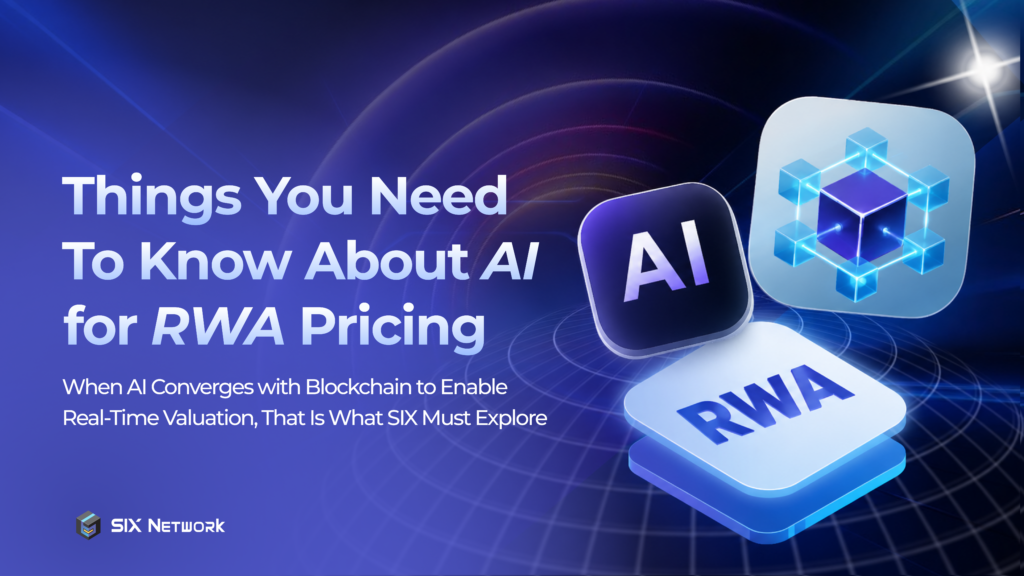
Things You Need To Know About AI for RWA Pricing

Things You Need To Know About AI for RWA Pricing

Things You Need To Know About AI: When AI Converges with Blockchain to Enable
Real-Time Valuation, That Is What SIX Must Explore

How AI Will Transform Asset Pricing in the Next Phase of RWA
Here’s What to Watch

What should determine the price of a real-world asset on Blockchain?


The question sounds simple. In practice, it is one of the hardest problems in RWA Tokenization, because real-world assets like real estate, funds, and securities carry value that depends on multiple variables at once: market conditions, macroeconomic data, jurisdiction-specific regulations, and factors unique to each asset itself.


The traditional answer has been to hire specialists to conduct valuations quarterly or annually. That worked in a world where things moved slowly. In a world of tokenized assets that trade around the clock, it no longer does.


AI is changing that equation.


A Market Growing Faster Than Most People Expected

The on-chain RWA market grew from approximately $5 billion in 2022 to $24 billion by mid-2025, a 380% increase in just a few years. And that growth has not come primarily from retail investors. It has come from institutions like BlackRock, Goldman Sachs, and BNY Mellon that have begun tokenizing real assets at production scale.


As more large institutions enter this space, the demand for infrastructure that can genuinely support compliance, identity, and settlement grows with them. That is precisely the ground SIX Protocol was built on from the beginning.


As of June 2024, 12% of real estate firms globally had already implemented tokenization, and 46% were actively piloting it. That number tells us something important: large financial institutions are currently deciding which infrastructure to build on. Whoever is ready to serve them first holds the advantage. This is why Institutional Assets sits in SIX’s 2026 Roadmap, not because it sounds good, but because the window to position as the infrastructure these institutions choose is open right now.


The Problem With Traditional Asset Pricing

Before talking about what AI will change, it helps to understand what is broken.


Valuations update too slowly. Traditional appraisals of real estate or funds happen in cycles, not in real time. During periods of rapid market movement, the price displayed may already be weeks or months out of date.


Tokenization using Blockchain helps reduce processes that typically pass through multiple intermediaries, which usually cost 2 to 5% of the asset value and take months to complete. But even if you remove the intermediaries, the problem of infrequent pricing remains. Without AI processing data in real time, a faster structure still relies on stale numbers.


There is also the problem of inconsistency, where two appraisers looking at the same asset can arrive at different figures, and fragmented data that must be manually aggregated from multiple sources. These are the bottlenecks that prevent the RWA market from scaling to its actual potential.


What AI Changes About RWA Pricing

AI models process market data, historical trends, and macroeconomic signals to deliver dynamic and transparent asset pricing. But that is only part of the picture, because AI changes the entire process, not just the final number.


Real-time valuation: Instead of waiting for a quarterly appraisal, an AI system reads current rental rates, the latest real estate indices, interest rate movements, and nearby transaction data, then computes the present value immediately. For tokenized assets that trade around the clock, this is not a convenience. It is a requirement.


Source: Medium / AI Tools for Real Estate Tokenization 2026


Detecting signals humans miss: AI can process large volumes of market data and historical trends far faster than any human and can identify patterns that often go unnoticed, such as the relationship between interest rate changes and real estate token values. This gives investors a more complete foundation for decision-making.

Source: Nadcab / AI Real Estate Tokenization 2026


Reducing valuation bias: When AI applies the same dataset and the same process every time, the inconsistency introduced by human judgment decreases. That makes it easier for investors to compare asset values across different tokenized projects on equal terms.

Source: Taazaa / Predicting Property Value Fluctuations with AI


Scaling compliance automatically: AI agents automate KYC/AML verification and jurisdictional compliance checks, significantly reducing legal risk exposure for tokenized assets. In a world where the same asset class carries different regulatory requirements depending on the country, this capability is what allows RWA projects to expand across borders in practice.


Source: Nadcab / AI Real Estate Tokenization 2026


Where Blockchain Fits in This Picture

AI makes pricing faster and more accurate. But it also raises a new question. If AI is determining what an asset is worth, who can prove what data it used, what process it followed, and that it was not manipulated?


AI transforms tokenization from a static digitization process into an intelligent system capable of real-time decision-making and continuous optimization. But a smarter system also requires greater transparency, because in institutional finance every number must be traceable.


When AI-generated valuations are recorded on-chain, every step becomes auditable: the input data the AI used, the process applied, and the result produced. All of it sits in an immutable record. For institutional investors who must demonstrate to regulators that the prices they use have a clear and verifiable origin, this is not optional. It is baseline infrastructure.


What to Watch in the Next Phase


Automated Valuation Models on Blockchain
 are beginning to emerge in real estate tokenization, particularly in markets where transaction data is dense enough to support them. These will serve as the template for AI-driven pricing across other asset classes.


Source: RIT Repository / Predictive Modeling of Tokenized Real Estate Prices


Dynamic NAV for tokenized funds:
 Tokenized dividend-paying funds including Treasury and money-market offerings grew 80% in 2025. As these funds trade around the clock, waiting for daily or weekly NAV calculations will become a bottleneck. AI that computes NAV in real time will shift from being an advantage to being a requirement.


Source: CoinLaw


Regulatory acceptance of AI-generated valuations: The passage of the GENIUS Act in July 2025 established a federal framework and standardized settlement infrastructure for payment stablecoins. It signals that regulators are getting more serious about setting rules for digital assets broadly. Once there is clarity on AI-generated valuations specifically, adoption will accelerate.


Source: Chainalysis


SIX’s Perspective

Real-time asset valuation has always been one of the clearest examples of a problem that Blockchain alone cannot solve. It requires both AI’s ability to process large volumes of data and Blockchain’s capacity to make that processing transparent and verifiable at the same time.


With 46% of real estate firms worldwide still in the process of piloting tokenization, the infrastructure that supports credible, accurate, and auditable asset pricing will be a deciding factor in which platforms these institutions choose when they are ready to deploy at scale.


SIX is actively exploring this direction, not because it is an interesting feature, but because we see it as a foundational requirement for RWA infrastructure that can genuinely serve institutional-grade use cases, and it is the reason Institutional Assets sits in SIX’s Roadmap this year.

Follow every update at
Website: https://six.network/
X: https://x.com/theSIXnetwork
FB: https://www.facebook.com/thesixnetwork/


And our community channels:

Discord: http://discord.gg/sixnetwork
Telegram: https://t.me/+0BmqYVoV5j5lN2Jl


• Read the full SIX Network Roadmap 2026: Click

• SIX Network Q1 2026 Summary: Read

⎯⎯⎯⎯⎯⎯⎯⎯⎯⎯⎯⎯⎯⎯⎯⎯⎯⎯⎯⎯⎯⎯⎯⎯⎯⎯⎯⎯⎯⎯⎯⎯

Disclaimer:

1.This article is intended for informational purposes only. Please conduct your own research before making any investment decisions related to cryptocurrencies 2. Cryptocurrency and digital token involve high risk; investors may lose all investment money and should study information carefully and make investments according to their own risk profile.


Don’t miss out follow us at:

Warisara Thepsiri
Warisara Thepsiri

Experience the magic of Blockchain with SIX Network!

Related Posts

SIX Network Q1 2026 Summary Building Blockchain Infrastructure Toward Institutional-Grade Financial Infrastructure

สรุปภาพรวม SIX Network ไตรมาส 1 ปี 2026

เริ่มพัฒนาโครงสร้างพื้นฐาน Blockchain สู่ Financial Infrastructure ระดับสถาบัน ตลาด RWA กำลังเข้าสู่จุดเปลี่ยนสำคัญ ไม่ใช่แค่การเติบโตในเชิงขนาด แต่รวมถึงการเข้ามาของผู้เล่นรายใหม่ ทั้งสถาบันการเงิน ผู้จัดการสินทรัพย์ และองค์กรระดับโลก ซึ่งพวกเขาไม่ได้มองหาแค่ blockchain แต่พวกเขากำลังมองหาโครงสร้างพื้นฐานที่รองรับความต้องการระดับสถาบันได้จริง ทำให้ในช่วงไตรมาส 1 ปี

Read More

Why SIX Network Is Building the Future with AI

Why SIX Network Is Building the Future with AI

AI Is Not Enough: You Need Blockchain Too Why SIX Is Building the Future with AI

AI Is Not Enough
Blockchain Makes It Work

We have previously told the story from the angle of AI coming in to help Blockchain and RWA work more smoothly. Now we want to talk about something equally important: the role of Blockchain at a time when everyone is turning to AI and AI agents, and why AI still lacks several critical capabilities that Blockchain can provide.


a16z crypto, one of the most closely followed voices in crypto and Web3 analysis, recently published an article titled “The Missing Infrastructure for AI Agents: 5 Ways Blockchains Can Help.” The article outlines 5 core things AI still cannot do on its own, but Blockchain can help with:


1. Identity for non-humans

2. Governing AI-run systems

3. Gaps in traditional payment systems

4. Repricing trust in the economy

5. Preserving user control

If AI agents operate alone, they still cannot fully deliver on all 5 of these. SIX Network has the tools to make each of them concrete, including payments, usage rights management, trustworthiness, and data verification. That infrastructure is SIX Protocol.


SIX Network builds technology that is right for this moment.

At a time when financial institutions and major projects are moving into RWA assets, building Blockchain-based systems, and deploying AI agents to help run operations,


SIX Network is building the complete infrastructure for an era where Blockchain and AI must work together.


We approach this not by chasing trends that may fade, but by studying the long-term direction of RWA Tokenization, a market that has been growing at a remarkable pace. As we have often said, the rise of RWA is drawing major financial institutions and a growing number of investors into this space. The more demand a market attracts, the more its value expands. That is a strong signal that RWA may become a foundational part of the Financial Infrastructure of the future.


Beyond a16z crypto, Eigen Labs, the team behind EigenLayer and a research and product development company currently exploring the intersection of crypto and AI just as we are, has written about AI agents in a way worth noting:

“We have come a long way, from rule-based bots to chatbots, from chatbots to agents that can use tools, and now we are moving toward autonomous agents that operate over longer and longer time horizons. But the next step is not just greater autonomy. It is ownership. Once agents own productive digital property, the question of investability follows naturally.”


All of this is why SIX has been actively studying and experimenting with how AI can be applied to Blockchain. Because it is not only a matter of AI becoming a tool that merges with Blockchain to form a complete solution. The reverse is equally true: AI having Blockchain as its foundation makes it more complete as well. For example, it helps reduce delivery timelines from projects that used to take months or years down to a single month. It makes system testing faster. It helps development teams catch errors in code or smart contracts early, before they reach production. All of this lowers the cost of building and lets teams focus more of their energy on what actually matters.


Blockchain at SIX Network

offers a complete solution for AI integration,

becoming a tool that genuinely works in full.


If you recall the gaps that a16z identified, covering identity, governance, payments, trust, and user control, what is worth noting is that SIX Protocol as the Blockchain infrastructure of SIX Network was built from the ground up in a way that already addresses each of them.


On transactions and trust: AI agents operating on SIX Protocol can execute and settle transactions in real time around the clock without going through intermediaries. More importantly, every transaction is recorded on-chain in a way that is fully transparent and cannot be altered, giving both financial institutions and users the ability to trace every step. In a world where AI is making transactions on behalf of humans, having a verifiable audit trail is not just a nice-to-have capability. It is a requirement.


On compliance: SIX Protocol supports automated verification of regulatory requirements. When an AI agent takes any action, the system can immediately verify whether that action falls within the legal boundaries of each relevant jurisdiction, without waiting for a human to review it manually. In the world of RWA Tokenization, where each asset class carries different rules depending on where it operates, this is precisely the capability that allows the system to scale.


On rights management: 

SIX Protocol has a permissions system encoded directly into smart contracts, allowing users to define clearly what an AI agent is and is not allowed to do, under what conditions, and with the ability to stop it immediately if something goes wrong. Those permissions are not a policy written on paper. They are code that is transparent, auditable, and enforceable at the protocol level.


The gaps that a16z identified as things AI agents still lack are addressed here. And that is why SIX sees Blockchain not merely as a complement to AI, but as the foundational structure that makes it possible for AI to operate meaningfully in the real world of finance.

Follow every update at
Website: https://six.network/
X: https://x.com/theSIXnetwork
FB: https://www.facebook.com/thesixnetwork/


And our community channels:

Discord: http://discord.gg/sixnetwork
Telegram: https://t.me/+0BmqYVoV5j5lN2Jl


• Read the full SIX Network Roadmap 2026: Click

• SIX Network Q1 2026 Summary: Read

⎯⎯⎯⎯⎯⎯⎯⎯⎯⎯⎯⎯⎯⎯⎯⎯⎯⎯⎯⎯⎯⎯⎯⎯⎯⎯⎯⎯⎯⎯⎯⎯

Disclaimer:

1.This article is intended for informational purposes only. Please conduct your own research before making any investment decisions related to cryptocurrencies 2. Cryptocurrency and digital token involve high risk; investors may lose all investment money and should study information carefully and make investments according to their own risk profile.


Don’t miss out follow us at:

Warisara Thepsiri
Warisara Thepsiri

Experience the magic of Blockchain with SIX Network!

Related Posts

SIX Network Q1 2026 Summary Building Blockchain Infrastructure Toward Institutional-Grade Financial Infrastructure

สรุปภาพรวม SIX Network ไตรมาส 1 ปี 2026

เริ่มพัฒนาโครงสร้างพื้นฐาน Blockchain สู่ Financial Infrastructure ระดับสถาบัน ตลาด RWA กำลังเข้าสู่จุดเปลี่ยนสำคัญ ไม่ใช่แค่การเติบโตในเชิงขนาด แต่รวมถึงการเข้ามาของผู้เล่นรายใหม่ ทั้งสถาบันการเงิน ผู้จัดการสินทรัพย์ และองค์กรระดับโลก ซึ่งพวกเขาไม่ได้มองหาแค่ blockchain แต่พวกเขากำลังมองหาโครงสร้างพื้นฐานที่รองรับความต้องการระดับสถาบันได้จริง ทำให้ในช่วงไตรมาส 1 ปี

Read More

RWA Needs an AI? Why SIX Network Is Bringing AI Into the Protocol

RWA Needs an AI? Why SIX Network Is Bringing AI Into the Protocol

RWA Needs an Assist? | Why SIX Network Is Bringing AI Into the Protocol

The next evolution of RWA is not about putting more assets on blockchain, but about making the underlying infrastructure more intelligent. SIX Network’s 2026 roadmap makes it clear that integrating AI is not about following a trend, but a necessary component for scaling toward institutional-grade operations.


The problem that is often overlooked

Tokenizing real-world assets may sound straightforward. Take a building, a bond, or gold, put it on blockchain to increase transparency and liquidity, and it is done.


In reality, every tokenized asset still relies on a series of manual processes. This includes compliance checks across different jurisdictions, KYC and AML procedures, token holder registry updates, smart contract auditing, and the integration of off-chain data.


Each of these steps carries a risk of human error if there is no system that ensures accuracy and reliability.


At the same time, the global RWA market is growing rapidly. Within just one year, it expanded fourfold, from $6.3 billion in early 2025 to over $25 billion in early 2026, according to RWA.xyz.


The more important question is not just how fast RWA is growing, but whether the current infrastructure is ready to support that level of scale. The answer increasingly points toward AI.


AI + Blockchain: Real use cases already happening

“AI + crypto” is widely discussed, but from SIX Network’s perspective, which is actively studying how AI can be applied to blockchain and RWA, the following are real use cases already happening in the industry and directly relevant to what SIX is building.

1. AI detecting on-chain fraud and suspicious transactions

Elliptic, a specialist in blockchain data analytics, trained AI across hundreds of millions of transactions and reported that money laundering detection accuracy improved to 27% up significantly from a very low baseline. The AI analyzes wallet clusters and transfer patterns to catch anomalies that humans miss. For a protocol managing real institutional assets, this is the baseline of trust that has to exist.

(Source: Elliptic / Blockchain Council, 2026)


2. AI-powered asset valuation and token structure design


Securitize, which received $47M in investment from BlackRock, uses automated systems to assess asset value and design token structures by feeding AI with market data, transaction history, and risk factors. Processes that previously took weeks have been compressed significantly. 


(Source: Suffescom / Securitize, 2026)


3. AI agents automating cross-border regulatory compliance


Zoniqx uses AI agents to continuously monitor and verify KYC/AML compliance and jurisdictional requirements automatically, without waiting for a legal team to review each step. The system operates across multiple countries simultaneously and updates itself when regulations change. This maps directly to what a protocol serving cross-border markets across Southeast Asia needs. 


(Source: Zoniqx, 2025)


4. AI-assisted smart contract writing and auditing

Blockchain Council reports that AI-assisted smart contract auditing is one of the fastest-growing use cases in 2026. Purpose-trained AI can flag potential vulnerabilities before the contract reaches a formal security review, reducing both the time and cost involved at this stage. 

(Source: Blockchain Council, 2026)


5. Institutional funds and assets driven by AI


Franklin Templeton launched the Franklin OnChain U.S. Government Money Fund, the first U.S.-registered mutual fund to record transactions on a public blockchain. BlackRock launched BUIDL, a tokenized money market fund. Both use automated systems to manage compliance and yield distribution. These are real, live examples of institutional-grade RWA where AI and blockchain are already working together. 


(Source: Velvosoft / Franklin Templeton / BlackRock, 2025)


SIX Network and the direction of AI

SIX Network’s position on this is clearly outlined in its 2026 roadmap.


The team is actively researching and preparing to integrate AI with blockchain operations at the protocol level. This is not because AI is a trend worth following, but because the ecosystem being built, whether in institutional asset tokenization, expanding asset diversity on-chain, or PayFi, can function more effectively with AI as part of the system.


More importantly, the infrastructure that SIX Protocol has developed over the years, including the Dynamic Data Layer, automated on-chain compliance, multi-country regulatory support, and token holder registry tracking, creates a structured data environment that AI requires to function effectively.


AI depends on high-quality, structured data. SIX already has that foundation. This is not starting from zero, but building on a system that has been developed with clear intent.


Wherever you sit in this ecosystem


• For asset owners and token issuers, processes that previously required manual effort, such as compliance checks, token holder updates, and investor verification, are moving toward automation. This leads to faster issuance and lower operational costs.


• For those following the SIX ecosystem, the infrastructure that has been built over the years, including SIX Garage, SIX Thruster, and the core SIX Protocol, becomes more valuable as AI is integrated. The structured data accumulated over time is what makes AI adoption practical.


• For developers and builders in Web3, the intersection of AI and RWA infrastructure is still relatively underdeveloped, but this will not remain the case for long.


The direction of SIX Network in 2026

The direction of SIX Network in 2026 is not simply about tokenizing more assets, but about making the entire system intelligent enough to support sustainable, institutional-scale growth.


Real RWA does not stop at putting assets on blockchain. It requires infrastructure that enables those assets to operate intelligently, transparently, and securely around the clock.


AI is the next layer that makes this possible, and SIX Protocol is more prepared to integrate it than most realize.

Follow every update at
Website: https://six.network/
X: https://x.com/theSIXnetwork
FB: https://www.facebook.com/thesixnetwork/


And our community channels:

Discord: http://discord.gg/sixnetwork
Telegram: https://t.me/+0BmqYVoV5j5lN2Jl


• Read the full SIX Network Roadmap 2026: Click

• SIX Network Q1 2026 Summary: Read

⎯⎯⎯⎯⎯⎯⎯⎯⎯⎯⎯⎯⎯⎯⎯⎯⎯⎯⎯⎯⎯⎯⎯⎯⎯⎯⎯⎯⎯⎯⎯⎯

Disclaimer:

1.This article is intended for informational purposes only. Please conduct your own research before making any investment decisions related to cryptocurrencies 2. Cryptocurrency and digital token involve high risk; investors may lose all investment money and should study information carefully and make investments according to their own risk profile.


Don’t miss out follow us at:

Warisara Thepsiri
Warisara Thepsiri

Experience the magic of Blockchain with SIX Network!

Related Posts

SIX Network Q1 2026 Summary Building Blockchain Infrastructure Toward Institutional-Grade Financial Infrastructure

สรุปภาพรวม SIX Network ไตรมาส 1 ปี 2026

เริ่มพัฒนาโครงสร้างพื้นฐาน Blockchain สู่ Financial Infrastructure ระดับสถาบัน ตลาด RWA กำลังเข้าสู่จุดเปลี่ยนสำคัญ ไม่ใช่แค่การเติบโตในเชิงขนาด แต่รวมถึงการเข้ามาของผู้เล่นรายใหม่ ทั้งสถาบันการเงิน ผู้จัดการสินทรัพย์ และองค์กรระดับโลก ซึ่งพวกเขาไม่ได้มองหาแค่ blockchain แต่พวกเขากำลังมองหาโครงสร้างพื้นฐานที่รองรับความต้องการระดับสถาบันได้จริง ทำให้ในช่วงไตรมาส 1 ปี

Read More

How AI and Blockchain Are Already Working Together Today

How AI and Blockchain Are Already Working Together Today

How AI and Blockchain Are Already Working Together Today

In 2024, global investment in AI and blockchain infrastructure exceeded $1.5 billion. This capital came from financial institutions, technology companies, and venture funds that are beginning to treat this convergence not as an experiment, but as a foundation for the next generation of financial systems.


Before AI and Blockchain Worked Together

Think about every time you interact with financial services, whether it is applying for a loan, transferring money across borders, or executing a business agreement.


Most processes still rely on intermediaries, take several days to complete, and involve recurring fees. More importantly, when something goes wrong, it can be difficult and time-consuming to trace the source of the issue.


Now consider what happens when AI is introduced into this system.


In blockchain-based transactions, AI can significantly improve both speed and accuracy. However, this introduces a new question. Who can trust the AI, and to what extent can its decisions be verified if there is no transparent system that explains how those decisions are made?


This is where blockchain becomes critical.


What Happens When AI and Blockchain Work Together


1. AI and blockchain in credit systems under regulatory frameworks


The EU AI Act in 2024 classifies AI systems used for credit scoring as high-risk systems that require clear documentation and auditability. Research published on arXiv in 2025 suggests that blockchain is one of the most suitable tools for creating immutable audit trails for AI decision-making, especially in consumer-facing applications.


Source: EU AI Act / arXiv: Blockchain as AI Transparency Platform


2. Blockchain-based payment systems without intermediaries


In September 2025, SWIFT announced the integration of a blockchain-based shared ledger into its infrastructure, with participation from more than 30 banks. Institutions such as UOB have indicated plans to use this system for ASEAN and cross-border payments, enabling real-time, 24/7 settlement.


Source: SWIFT press release, Sep 2025


3. AI-powered smart contracts for crop insurance


Projects involving Etherisc, Lemonade Crypto Climate Coalition, Chainlink, and Hannover Re have launched blockchain-based crop insurance in Kenya, covering over 7,000 farmers. When drought conditions are detected through environmental sensors, payouts are triggered automatically through smart contracts. AI-powered parametric systems can settle claims within 48 hours, compared to an average of 19 days in traditional systems.


Source: ItisPay / Insurnest


4. Data transparency for AI training


Ocean Protocol has developed a marketplace where data providers can tokenize their datasets and receive compensation each time their data is used to train AI models. In 2024, Ocean merged with Fetch.ai and SingularityNET to form the Artificial Superintelligence Alliance, with a combined valuation exceeding $7.5 billion. This reflects a growing recognition of data as a core asset in the AI economy.


Source: AI Git / Blockchain Council


Signals from Blockchain Industry Leaders

Industry leaders are increasingly aligned on the importance of this convergence.


CZ, founder of Binance, sees AI and blockchain as one of the most important technological convergences of this decade, particularly in identity and automated financial systems.


Vitalik Buterin, co-founder of Ethereum, raises a deeper question about trust. How can AI systems be made verifiable at a fundamental level? His direction points toward using cryptographic proofs, the same foundation that makes blockchain trustworthy, to validate AI processes.


Both perspectives point in the same direction. AI becomes significantly more powerful in financial systems when it is verifiable, and blockchain provides that verification layer.


How SIX Network Sees This Opportunity

From the examples above, it is clear that AI and blockchain are no longer just future concepts. They are already being applied in real financial infrastructure, from credit systems and payment networks to data management and insurance. Together, these developments point to a broader shift, where systems that are automated, accurate, and verifiable are becoming the new standard for the industry.


SIX Network has not only recently started exploring this space. At its core, what we have been building has always been infrastructure designed to support real-world assets, which is exactly where the integration of AI and blockchain can create the most practical and impactful use cases. This includes areas such as on-chain transaction verification, AI-assisted smart contract execution, and the development of systems that can operate autonomously at the infrastructure level.


Whether it is transaction verification on-chain, AI-assisted smart contract execution, or other operational layers, these are areas where real use cases are already emerging.


In the context of RWA tokenization, including real estate, funds, and securities, key questions remain. Can risk be assessed accurately enough? Can compliance be automated reliably? Can systems respond to market conditions in time? 


SIX is actively studying how AI can be integrated into financial infrastructure, not to appear innovative, but because infrastructure that supports institutional-scale projects must be intelligent, automated, efficient, accurate, and trustworthy at the same time.


The Road Ahead for SIX

There are still technical challenges to address. The integration of AI and blockchain at scale within the SIX Network ecosystem will take time.


At this stage, SIX is actively researching how AI can be applied in real blockchain operations to maximize efficiency, both within the SIX ecosystem and in collaboration with partners and future projects.

Follow every update at
Website: https://six.network/
X: https://x.com/theSIXnetwork
FB: https://www.facebook.com/thesixnetwork/


And our community channels:

Discord: http://discord.gg/sixnetwork
Telegram: https://t.me/+0BmqYVoV5j5lN2Jl


• Read the full SIX Network Roadmap 2026: Click

• SIX Network Q1 2026 Summary: Read

⎯⎯⎯⎯⎯⎯⎯⎯⎯⎯⎯⎯⎯⎯⎯⎯⎯⎯⎯⎯⎯⎯⎯⎯⎯⎯⎯⎯⎯⎯⎯⎯

Disclaimer:

1.This article is intended for informational purposes only. Please conduct your own research before making any investment decisions related to cryptocurrencies 2. Cryptocurrency and digital token involve high risk; investors may lose all investment money and should study information carefully and make investments according to their own risk profile.


Don’t miss out follow us at:

Warisara Thepsiri
Warisara Thepsiri

Experience the magic of Blockchain with SIX Network!

Related Posts

SIX Network Q1 2026 Summary Building Blockchain Infrastructure Toward Institutional-Grade Financial Infrastructure

สรุปภาพรวม SIX Network ไตรมาส 1 ปี 2026

เริ่มพัฒนาโครงสร้างพื้นฐาน Blockchain สู่ Financial Infrastructure ระดับสถาบัน ตลาด RWA กำลังเข้าสู่จุดเปลี่ยนสำคัญ ไม่ใช่แค่การเติบโตในเชิงขนาด แต่รวมถึงการเข้ามาของผู้เล่นรายใหม่ ทั้งสถาบันการเงิน ผู้จัดการสินทรัพย์ และองค์กรระดับโลก ซึ่งพวกเขาไม่ได้มองหาแค่ blockchain แต่พวกเขากำลังมองหาโครงสร้างพื้นฐานที่รองรับความต้องการระดับสถาบันได้จริง ทำให้ในช่วงไตรมาส 1 ปี

Read More